Reading, Writing: Hell
By Alexander Laurence
After Kathy Acker
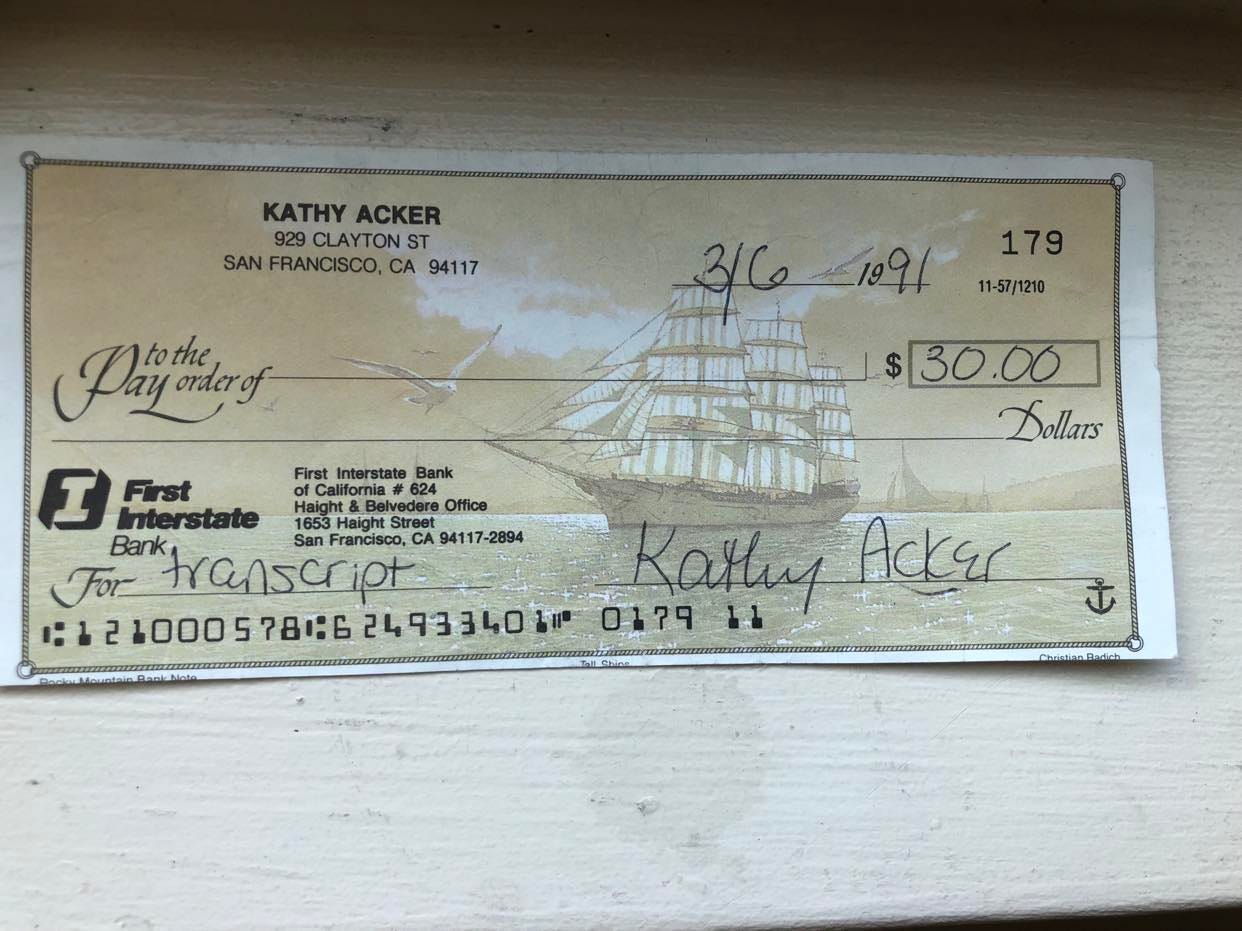
Many years have passed since I first walked into Kathy Acker’s writing class at the San Francisco Art Institute.
It was August 1991. Punk culture had become part of the mainstream, San Francisco still felt dangerous and experimental, and Kathy Acker had already become a literary legend. The course was listed in the catalog under the title Reading, Writing: Hell.
The name alone was enough to attract attention.
On the first day, forty or fifty students crowded into the room—twice as many as Kathy had wanted. Her previous classes, I was told, had been small and intimate. Word had spread. Writers, artists, photographers, filmmakers, performance artists, and assorted wanderers had all arrived hoping to see what would happen.
Kathy entered the room and immediately commanded everyone’s attention.
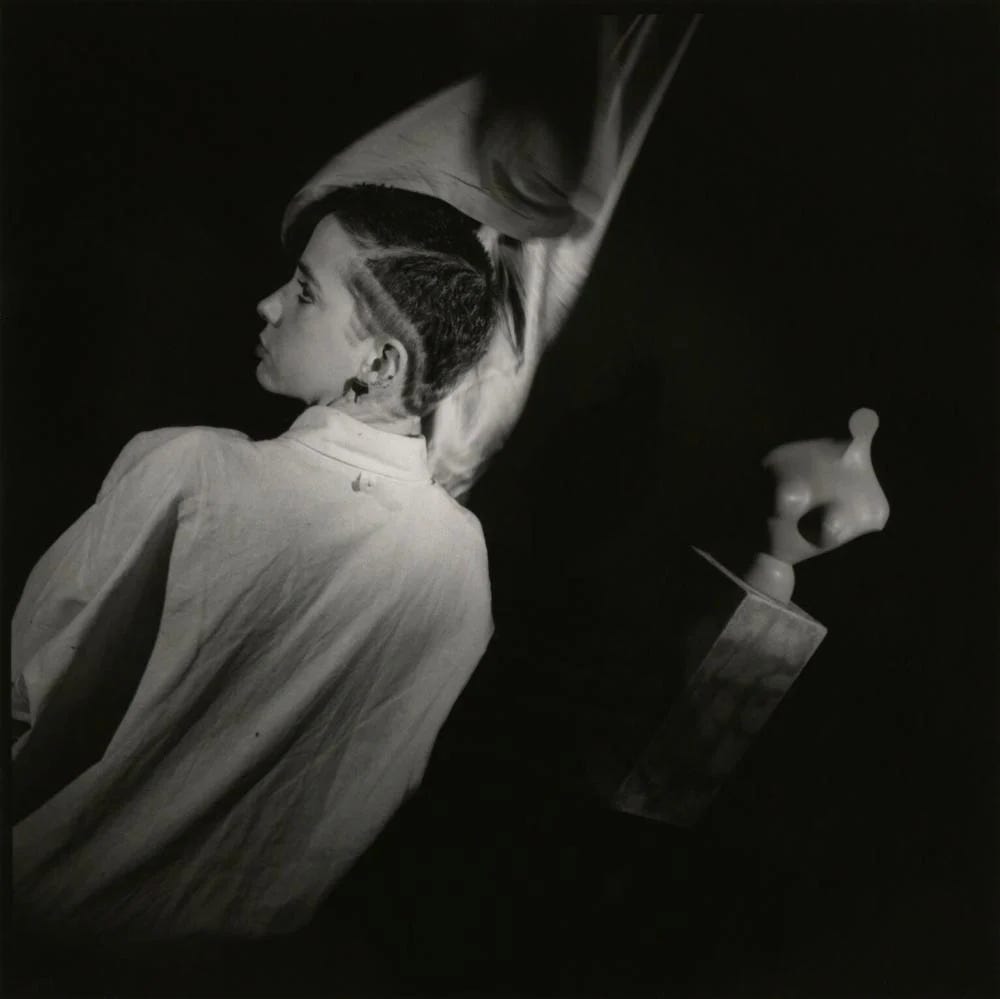
She was unlike any teacher I had ever encountered. Small in stature, with a shaved head, tattoos, a leather jacket, and a thick Brooklyn accent, she possessed an intensity that made the room feel smaller. Every sentence sounded deliberate. Every remark felt like a challenge.
Without ceremony she outlined the course:
“One-third reading. One-third writing. One-third visiting writers.”
That was the entire syllabus.
The class itself reflected the culture of the Art Institute. Most students were painters or photographers. A handful came from film or performance art. Very few had any formal background in creative writing. The group was diverse in every imaginable way except literary experience.
I was something of an outsider.
I wasn’t enrolled for credit. I had already completed a degree in English literature years earlier and was sitting in unofficially. Before arriving, I had read several of Acker’s novels, along with a great deal of French theory, philosophy, and modern literature. In terms of reading, I was probably one of the most prepared students in the room.
That did not impress Kathy.
At the time she was reading Nabokov’s Lolita and working on what would later become My Mother: Demonology. During that first meeting she casually mentioned a list of writers that would become the intellectual landscape of the semester: Rimbaud, Baudelaire, Emily Brontë, Borges, Artaud, Bataille, Faulkner, Thomas Bernhard, Juan Goytisolo, Severo Sarduy, and the Situationists.
The list felt less like a syllabus than a map of her obsessions.
She asked each of us to select a book and prepare a presentation on it later in the semester. I chose Gilbert Sorrentino’s Under the Shadow, which I had recently acquired in galley form.
Kathy approved, though not enthusiastically.
She preferred dead writers.
Living writers, she suggested, had not yet earned their place in history.
Half the class chose Lolita. Several others selected Burroughs. Even then I noticed how easily literary influence became imitation.
A few days later Kathy asked to see samples of my writing.
I gave her several stories.
After reading them she returned the pages and said, almost dismissively:
“This is a class for beginning writers.”
I told her I wanted to stay anyway.
She compared my work to Paul Auster.
At the time I took that as a compliment. Years later I realized it was not intended as one.
The first few weeks were a process of elimination.
Kathy openly tried to discourage people from remaining in the course. Too many students had enrolled. She needed to cut the class in half.
Her method was simple: make everyone uncomfortable.
The first assignment was deceptively straightforward.
Write about the most dysfunctional member of your family.
The room filled with nervous laughter as forty people bent over notebooks.
Then came the second instruction.
Now write about having sex with that person.
The laughter disappeared.
Some students refused outright. Others stared at their pages in horror. Most eventually wrote something.
Then Kathy asked everyone to read their work aloud.
For nearly an hour we listened to an extraordinary collection of confessions, fantasies, jokes, evasions, nightmares, and embarrassments. Some pieces sounded like pornography. Others sounded like therapy sessions. A few resembled performance art.
Kathy listened quietly.
When the readings ended, she explained that the exercise had almost nothing to do with sex.
What interested her was the word “I.”
She wanted to force us into a position where autobiography became unstable, where the distance between experience, fantasy, memory, and invention collapsed.
The assignment wasn’t about confession.
It was about discovering what happened to language when it became dangerous.
Many students never returned after that day.
The rest of us stayed.
And that was when the class truly began.
Learning to Read Differently
Once the class had been reduced to roughly twenty students, Kathy’s real project emerged.
The course was ostensibly about writing, but writing was only half of it. What she was really teaching was a way of reading.
Most creative writing workshops begin with craft: character, dialogue, plot, scene. Kathy began somewhere else entirely. She began with Georges Bataille.
At the center of the course was Bataille’s Literature and Evil, a book that fascinated her. She spoke constantly about transgression, desire, law, dreams, violence, and the strange places where literature crossed into forbidden territory.
One day she assigned us Wuthering Heights.
I remember asking her whether Bataille’s Story of the Eye might be understood as a twentieth-century version of Brontë’s novel.
She paused.
For a moment she seemed genuinely interested.
“Maybe,” she said. “I’ll have to think about that.”
It was one of the few times during the semester that I felt I had surprised her.
Most of Kathy’s assignments were unlike anything I had encountered in a university classroom.
She rarely asked us to write polished stories.
Instead, she designed situations.
Experiments.
Traps.
One week we exchanged descriptions of dreams anonymously. Another week we wrote definitions of “the law” and then wrote stories based on someone else’s definition. She seemed less interested in finished work than in creating collisions between language, identity, and unconscious desire.
Many assignments failed.
She didn’t care.
Failure was part of the process.
What interested her was discovering what happened when writers were pushed beyond their habits.
I remember one exercise in which we were asked to write a difficult letter to someone. Another required us to imagine a dying lover’s final words. Another asked us to describe our own death.
The assignments often felt impossible.
That was the point.
Kathy believed that writing should lead a person into territory they did not already understand.
She frequently spoke about dreams.
Dreams fascinated her because they escaped explanation. They ignored ordinary narrative logic. They moved through association, emotion, and image.
Years later, when I reread My Mother: Demonology, it struck me as one enormous dream narrative.
The classroom itself sometimes resembled one.
Kathy would lecture intensely for twenty minutes about Bataille, Blanchot, Borges, or Rimbaud. Then someone would read a bizarre autobiographical fragment involving sex, death, religion, or childhood trauma. Then she would put on a cassette tape.
N.W.A.
Nine Inch Nails.
Something loud.
Then another student would read.
The class moved according to rhythms that felt closer to performance art than education.
Many students found this frustrating.
Some wanted feedback.
Some wanted encouragement.
Some wanted grades.
Kathy offered very little of any of those things.
Instead, she challenged assumptions.
Why write?
What makes a sentence alive?
Why are certain subjects forbidden?
What happens when a writer abandons control?
These were the questions that interested her.
And if you wanted answers, you had to discover them yourself.
Finding a New Voice
When I entered Kathy’s class, I already thought of myself as a writer.
I had studied English literature. I had written stories, poems, essays, and reviews. I had read widely, perhaps more widely than anyone else in the room except Kathy herself. I was interested in formal experimentation, structural constraints, and literary games.
At the time I was reading Georges Perec and the writers associated with Oulipo. I admired Raymond Queneau’s Exercises in Style. I wrote haiku, pangrams, and pieces built around formal systems. Often, I began with a structure and then filled it with language.
Kathy’s approach was almost the opposite.
She distrusted systems.
Or perhaps more accurately, she distrusted systems that became an end in themselves.
What interested her was intuition, dreams, desire, and the unconscious. She wanted writing to surprise the writer.
I resisted this at first.
Many of her assignments struck me as deliberately irrational. She seemed determined to push language toward nonsense, toward babble, toward places where meaning became unstable. As someone who admired structure, I often found myself pushing back.
But gradually something changed.
I began to realize that Kathy was not opposed to form. She was opposed to predictability.
She wanted writing that felt dangerous.
Not dangerous because it was shocking, but because neither the writer nor the reader knew exactly where it would lead.
One of the most talented students in the class was Jill St. Jacques.
At the time I barely knew her. Kathy encouraged a certain degree of individualism and discouraged the formation of cliques. We spent months in the same room without speaking much to one another.
Years later I would realize how much Jill had been absorbing from those classes.
She seemed to understand immediately what Kathy was after.
I was slower.
I kept trying to intellectualize everything.
Jill once described the process as exhausting a line of thought until you reached a wall, then pushing through it until you reached another wall.
That description has stayed with me.
Many of Kathy’s assignments were designed precisely to produce that sensation.
You would write until your ordinary habits failed.
Then you would keep going.
Somewhere beyond that point, something unexpected might happen.
Or nothing would happen.
But the possibility was there.
Around this time, I began working on a piece that would eventually become Audrey Hepburn.
It started almost accidentally.
Kathy had assigned us a moral essay, inspired in part by our discussions of Sade. I arrived with a text that was provocative, fragmentary, and deliberately excessive. It borrowed freely from other writers. It ignored many of the formal rules I had previously imposed on myself.
For the first time in years, writing felt genuinely unpredictable.
I wasn’t trying to construct a perfect object.
I was trying to discover what would happen next.
When Kathy responded positively to the piece, I felt as though something had opened.
The breakthrough wasn’t stylistic.
It was psychological.
I had stopped asking permission.
That may have been the most important lesson Kathy taught anyone.
Not how to write.
How to trust the act of writing.
Theft, Desire, and Audrey Hepburn
As the semester progressed, Kathy became increasingly interested in questions of appropriation, desire, and literary theft.
Not plagiarism in the academic sense. Something more radical.
She wanted us to understand that writing emerged from other writing.
One afternoon she walked into class carrying a stack of books and announced that originality was overrated.
“Steal lines,” she told us.
The statement shocked some people.
“Copy things. Take sentences. Use them. Change them. Commit crimes.”
She was talking about literature, of course, but Kathy liked to frame artistic practice in terms of transgression. The language of crime interested her because it suggested that writing was an activity that crossed boundaries.
At the time I was reading Ezra Pound, Juan Goytisolo, Amy Gerstler, and Bob Flanagan. I opened the books at random and began copying phrases, fragments, and images into a notebook.
Then I rearranged them.
The results were chaotic.
Unexpected collisions occurred. Meanings emerged that none of the original texts had intended. Images connected themselves to other images. Voices merged and separated.
For perhaps the first time, I began to understand what Kathy meant when she spoke about intuition.
The writer was not inventing everything.
The writer was creating conditions under which things could happen.
This realization coincided with one of the most difficult periods of my life.
I was twenty-seven years old.
Several friendships were disintegrating. Arguments hardened into feuds. Depression, which had followed me through much of my twenties, was reaching its final and most exhausting stage.
I remember feeling trapped between competing versions of myself.
One part of me wanted control.
Another wanted freedom.
The writing reflected this conflict.
Everything I produced seemed caught between structure and chaos.
Then Kathy assigned us a moral essay.
The assignment emerged from our ongoing discussions of the Marquis de Sade, Bataille, and the relationship between morality and literature. I don’t remember exactly what she asked for. What I remember is sitting down and deciding not to censor myself.
The piece that emerged eventually became Audrey Hepburn.
At the time it was little more than a fragment.
A provocation.
A collage.
An act of literary theft.
I borrowed freely from Gilbert Sorrentino and other sources. The voice was exaggerated. The tone was deliberately offensive. I wanted the writing to move with the speed of thought rather than the discipline of conventional storytelling.
The result felt unlike anything I had written before.
For years I had been interested in form.
Now I was interested in permission.
The permission to say anything.
The permission to move anywhere.
The permission to be contradictory.
When Kathy read the piece, she responded enthusiastically.
It was one of the few times during the semester that I felt she genuinely approved of something I had written.
More important than her approval, however, was my own reaction.
For the first time in years, I felt excited by my writing.
Not pleased.
Not satisfied.
Excited.
The difference mattered.
Satisfaction belongs to completion.
Excitement belongs to discovery.
I began to feel that writing could contain anything: autobiography, philosophy, dreams, quotations, jokes, criticism, pornography, confession, lies.
Everything became material.
Everything could be transformed.
Looking back, I think that was the real breakthrough.
Not Audrey Hepburn itself.
The realization that literature was larger than the categories I had inherited.
Kathy did not teach me how to write.
She taught me how to stop preventing myself from writing.
That lesson arrived at exactly the right moment.
Had I taken the class five years earlier, I might not have understood it.
Had I taken it five years later, I might have resisted it.
But in 1991, sitting in that room at the Art Institute, surrounded by painters, photographers, performers, and aspiring writers, I was ready to hear it.
Or at least ready to argue with it.
Which, in Kathy’s world, was often the same thing.
Writing About Death
As the semester moved toward its end, Kathy became increasingly interested in death.
Not death as a literary theme.
Death as an impossibility.
At the time we were reading Maurice Blanchot, particularly The Unavowable Community and Madness of the Day. Kathy spoke for entire classes about Blanchot, Bataille, Klossowski, and the strange territory where philosophy and fiction became indistinguishable.
I remember one quotation that she returned to repeatedly:
“The narrative voice is a voice that has no place in the work.”
Kathy loved statements like that.
Not because they could be explained but because they could not.
She wanted writing to move toward the limits of thought.
She wanted it to encounter what could not easily be represented.
Death was one of those limits.
One afternoon she gave us an assignment:
Describe your own death.
The room fell silent.
It sounded simple.
It wasn’t.
The problem, as Kathy explained, was that no one can actually imagine their own death. The mind can imagine pain, fear, injury, loss, and grief. But death itself remains inaccessible.
It is always someone else’s experience.
I found myself writing about dreams.
In the text I produced, I died repeatedly.
I was eaten alive.
Buried.
Destroyed.
Then somehow consciousness continued.
I returned again and again in different forms.
At one point I became fertilizer.
At another I was reduced to fragments but continued thinking.
The piece was absurd, grotesque, and strangely comic.
Looking back, I realize that I was less interested in death than in persistence.
I could imagine transformation.
I could not imagine disappearance.
Much of what I wrote eventually became part of a story called Undiscovered Country.
At the same time I found myself moving away from death and toward something else.
Birth.
Or perhaps rebirth.
The depression that had accompanied much of my twenties was beginning to lift. Old friendships were ending. New conflicts were emerging. Everything felt unstable.
Writing became a way of reorganizing experience.
If Audrey Hepburn represented one breakthrough, My Birth represented another.
The title was intentionally direct.
I wanted to begin again.
The piece emerged almost as an answer to all the death writing we had been doing. If Kathy wanted us to imagine our deaths, I wanted to imagine what came afterward.
Not heaven.
Not transcendence.
Simply another beginning.
I remember reading an early draft aloud in class.
The reaction was uncertain.
Several students looked confused.
Others seemed uncomfortable.
Some preferred the more aggressive energy of Audrey Hepburn.
But Kathy surprised me.
She thought My Birth was one of the strongest things I had written all semester.
That mattered.
Not because I needed approval.
But because she had understood what I was trying to do.
Which was rare.
The class often felt like a room full of people speaking different languages.
Kathy spoke Bataille.
Someone else spoke performance art.
Someone else spoke punk rock.
Someone else spoke therapy.
Most of us were translating constantly.
Yet every once in a while, communication happened.
This was one of those moments.
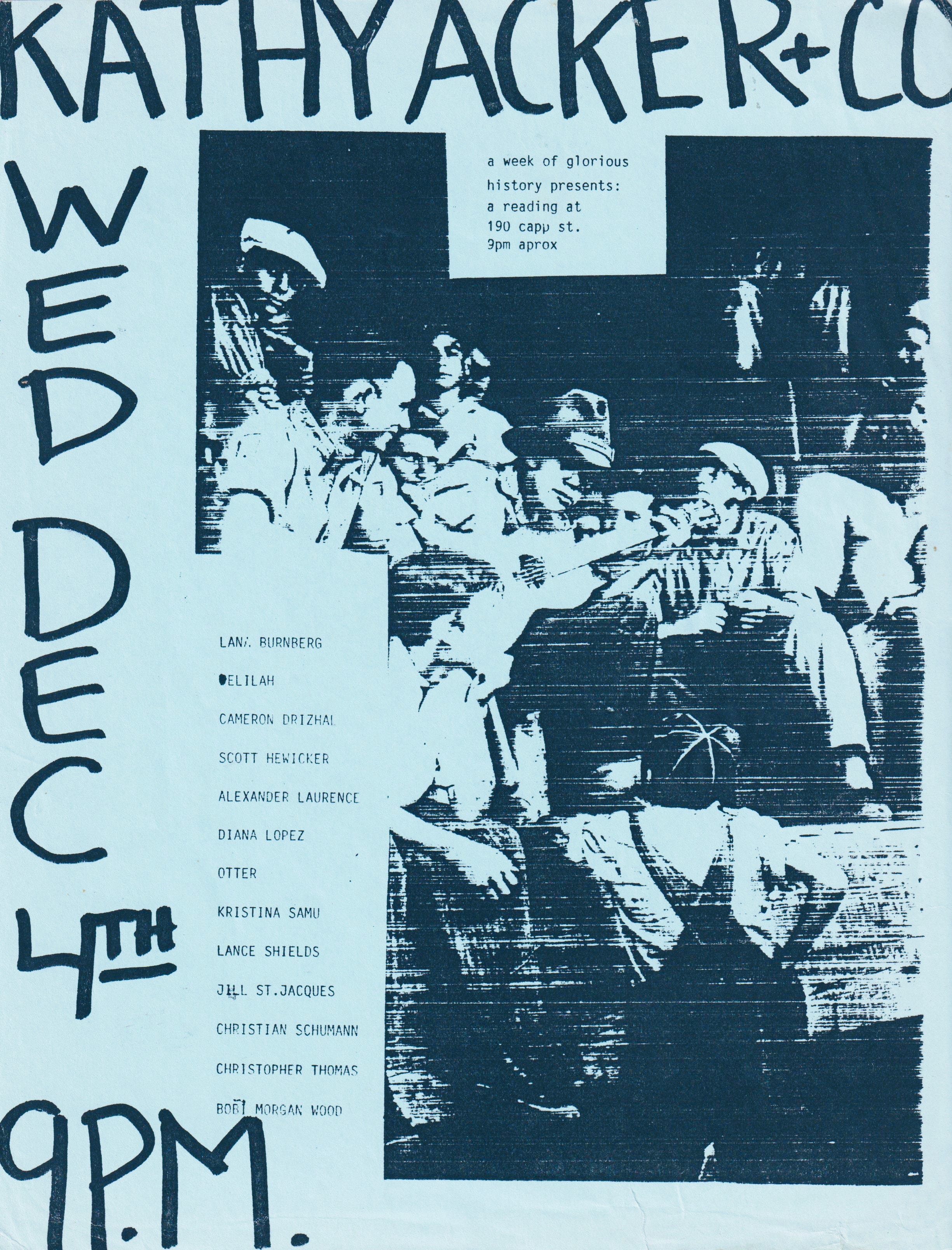
The semester culminated in a public reading at a small art space called Anti-Matter.
Like many literary events in San Francisco during the early 1990s, it was chaotic.
We had spent our final class preparing.
People rehearsed.
Texts were revised.
Some students were nervous.
Others behaved as though they were about to headline Madison Square Garden.
The actual event quickly collapsed.
Audience members began heckling almost immediately.
Performances were interrupted.
People drank too much.
One reader attempted a piece based on Blade Runner while someone else shouted responses from the audience.
The atmosphere grew increasingly unruly.
It was less a literary reading than a minor social catastrophe.
Which, in retrospect, made it very San Francisco.
I read My Birth.
It was the first public reading of the piece.
I remember feeling oddly calm.
By then I had stopped worrying about whether people understood what I was doing.
That anxiety had disappeared somewhere during the semester.
Kathy had cured me of it.
Or perhaps exhausted it.
The reading itself was a disaster.
The experience was a success.
There is a difference.
One concerns performance.
The other concerns becoming the writer you are going to be.
Kathy
What I remember most clearly now are not the theories.
Not Bataille.
Not Blanchot.
Not even the assignments.
I remember Kathy herself.
I remember her showing up with books under her arm and talking about whatever had captured her attention that week. One week it was Foucault. Another it was Duras. Another it was the Clarence Thomas hearings, which she followed with a fascination that I never shared. She seemed genuinely invested in the drama of power wherever she found it—literature, politics, sexuality, philosophy.
I remember her dismissing Paul Auster.
I remember her enthusiasm for Borges.
I remember her reading passages aloud and suddenly stopping to interrogate a sentence as though it were a suspect in a crime.
I remember the music between readings: N.W.A., Nine Inch Nails, whatever tape she happened to have brought with her that day.
I remember her telling us to steal.
I remember her telling us to dream.
I remember her telling us not to worry about making sense.
Once she asked me why I wrote in so many different styles.
I told her I became bored easily.
She laughed.
Or maybe she didn’t. Memory edits as much as it preserves.
The truth is that Kathy herself seemed to exist in several styles at once.
She could move from literary theory to punk culture, from Bataille to bodybuilding, from dreams to politics, often in the same conversation.
That combination was what made her compelling.
She treated literature as though it belonged to life rather than the university.
And for a room full of young artists in San Francisco in 1991, that made all the difference.
What Remains
The semester ended the way most semesters end.
Not with revelation.
Not with mastery.
Not with certainty.
People drifted away.
Some continued writing. Others disappeared into different lives. A few became artists. A few stopped making art altogether. The little community that had existed for fifteen weeks dissolved almost immediately.
At the time I thought the important thing was the work itself.
The stories.
The exercises.
The books.
The theories.
Years later I realized that none of those things were the real subject.
What stayed with me was Kathy.
Not Kathy Acker the literary celebrity.
Not Kathy Acker the controversial novelist.
Not Kathy Acker the public figure.
Kathy Acker the teacher.
I remember her sitting in a chair listening to students read. I remember her impatience when writing felt dishonest. I remember her excitement when someone accidentally discovered something they did not know they were capable of writing.
What impressed me most was not her intelligence, although she was extraordinarily intelligent.
It was her seriousness.
She believed literature mattered.
Not in the institutional sense.
Not because books were respectable.
Quite the opposite.
She believed literature mattered because it was dangerous.
Because it could alter consciousness.
Because it could change the way a person understood themselves.
Because it could reveal things that ordinary speech concealed.
Many writing teachers teach technique.
Kathy taught permission.
Permission to fail.
Permission to embarrass yourself.
Permission to write badly.
Permission to write too much.
Permission to follow an obsession further than seemed reasonable.
Permission to become lost.
For someone in his late twenties who had already spent years reading and writing, that turned out to be more valuable than any lesson in craft.
I did not become a disciple of Kathy Acker.
I did not begin writing like Kathy Acker.
In fact, much of my work continued to move in directions quite different from hers.
But she functioned as a catalyst.
She accelerated processes that had already begun.
She encouraged risks I might otherwise have avoided.
She made experimentation seem necessary rather than optional.
Looking back now, I can see that many of the works I wrote during the years that followed emerged from questions first raised in that classroom.
Questions about identity.
Questions about desire.
Questions about memory.
Questions about how much of writing is invention and how much is confession.
Questions I am still asking.
The older I become, the less interested I am in literary movements, schools, manifestos, and theories.
What interests me now are people.
The teachers who arrive at the right moment.
The friends who change the course of a life.
The writers who give us permission to become ourselves.
Kathy was one of those people.
I have forgotten many of the details of that semester.
I no longer remember every assignment.
I no longer remember every discussion.
Many of the notebooks have disappeared.
Some of the stories are lost.
Yet when I think back to the fall of 1991, I still see Kathy standing at the front of that room at the Art Institute.
Small.
Shaved head.
Leather jacket.
Talking about Bataille, Rimbaud, dreams, crime, and literature as if they were all part of the same conversation.
Perhaps they were.
At twenty-seven, I walked into her classroom thinking that writing was primarily a matter of technique.
I left understanding that writing was also a matter of courage.
That lesson has remained with me longer than any book on the syllabus.
Long after the assignments were forgotten.
Long after the class ended.
Long after Kathy herself was gone.